
As an Amazon Associate, Kulture Scientific earns from qualifying purchases.
You open the incubator. You pull out your flask. You put it under the scope. And there they are -- or rather, there they were. A flask full of rounded, detached, unhappy cells that definitely were not looking like that yesterday.
If you have spent any time in a cell culture lab, you have lived this moment. It is frustrating, time-consuming, and sometimes experiment-ending. The hard part is that cell death in culture rarely comes with an obvious cause and an obvious fix. It is usually a process of elimination, and if you are not working systematically, you can spend days chasing the wrong suspect.
This guide walks through the most common culprits, from the quick wins to the sneaky ones that take weeks to catch. Whether you are new to cell culture or a seasoned researcher dealing with an unfamiliar cell line, work through these categories before you panic-order new reagents or blame the cells.
1. Rule Out Contamination First
Before you touch anything else, look at your media. If it has gone from pink to yellow overnight, or you can see cloudiness or anything that looks like it is growing, stop. You almost certainly have contamination. For most cell lines, the right call is to discard the flask and decontaminate your hood. In the vast majority of cases, attempting to rescue a contaminated culture is not worth the risk of spreading the problem to your other cultures.
That said, there are rare situations where rescue may be attempted. If you are working with a truly irreplaceable primary cell preparation with no frozen backup, salvage protocols do exist. That process has enough nuance to deserve its own dedicated post, so we will cover it separately.
Bacterial and fungal contamination are usually visible, which is almost a mercy. What is not visible, and far more common than most labs realize, is mycoplasma. Estimates suggest somewhere between 15% and 35% of cell cultures in active labs are mycoplasma-positive at any given time. Mycoplasma will not cloud your media or produce any visible growth, but it will slowly degrade your cells. Slower growth, reduced viability, altered gene expression, and compromised experimental results are all classic signs. If you have chronic low-level cell death that you cannot explain any other way, mycoplasma belongs on your list.
Test with a PCR-based kit if you have any suspicion, or make it a routine screen every one to two months in a shared lab environment. Contaminated cultures should be discarded. Start fresh from a clean frozen stock.
Pro Tip: Work Backwards to Find the Source
If contamination keeps coming back and you are not sure where it is coming from, do not just discard and repeat. Work backwards using process of elimination. Start with a T-25 flask containing media only. Incubate it for a few days. If it stays clean, add serum. If that stays clean, add your other reagents one at a time: supplements, antibiotics, whatever you routinely use. This approach will isolate whether the source is your technique, your media, your serum, or a specific reagent lot.
It takes more patience than most people want to spend when their experiment is already off the rails, but it is genuinely the fastest way to get a real answer instead of just starting over and hoping for a different result.
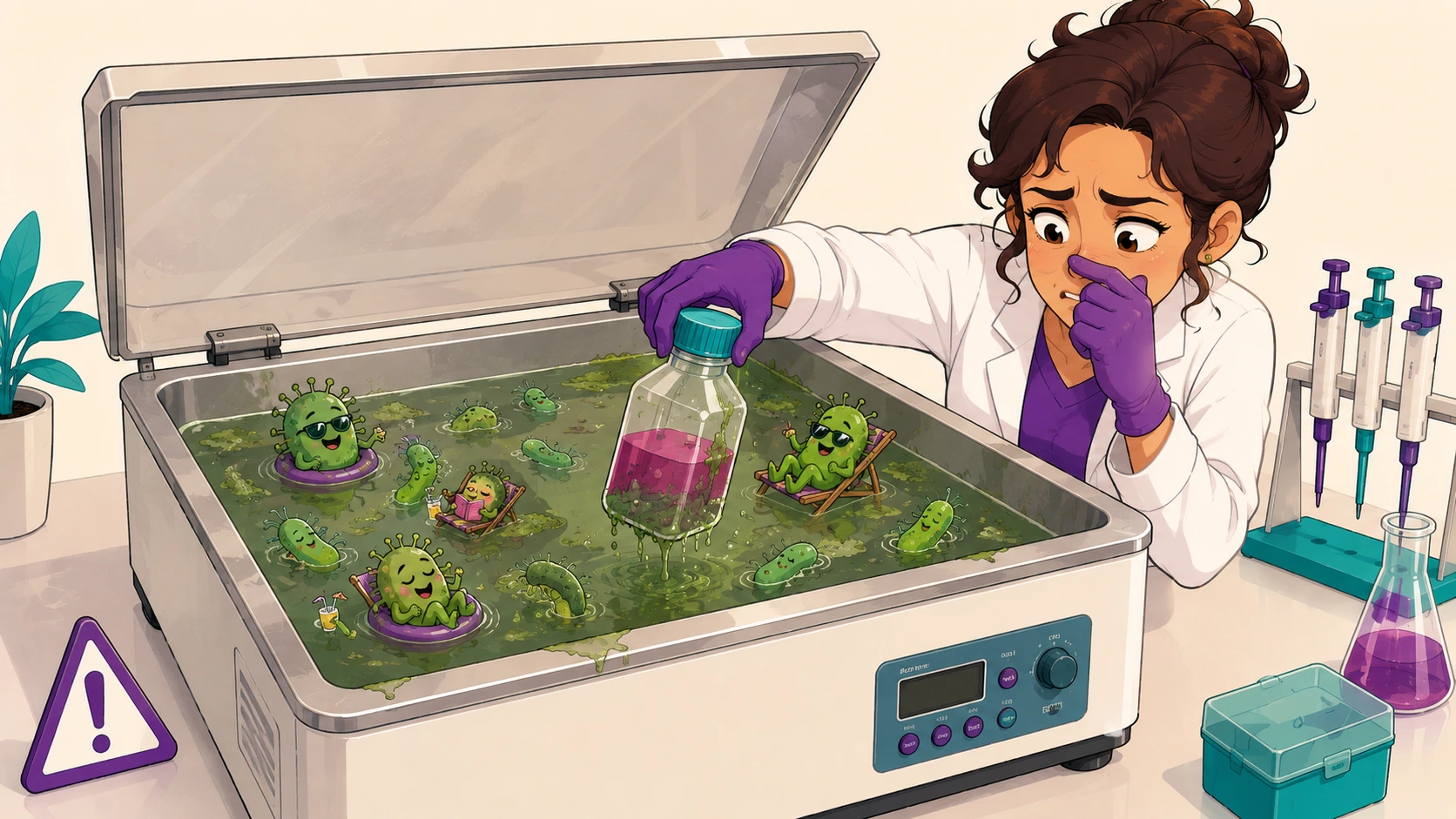
Image generated with AI image generation tool.
Pro Tip: Your Water Bath Is Probably Filthy
Water baths are one of the most notorious and most overlooked sources of contamination in cell culture labs. That warm, wet environment is basically a spa for bacteria and algae, and every time you dip a bottle of media into it, you are picking up whatever is living in that water and transferring it to your work surface and your hands.
Change the water frequently, more often than feels necessary. For keeping growth under control between changes, you have a few options:
- Commercial algae inhibitor: Products formulated specifically for lab water baths work well and are straightforward to use. Check the label for concentration since formulations vary, but something in the range of 0.01% is typical. a dedicated lab water bath algae inhibitor. Always follow the product's specific instructions.
- Copper sulfate: The old-school approach that actually works. A dilute copper sulfate solution suppresses algae and microbial growth effectively because copper ions disrupt algal membranes at very low concentrations. Target a very dilute solution around 0.01% and do not go overboard. If you prefer a ready-made product, this is one option we have seen recommended (Amazon). The classic workaround was dropping a pre-1982 copper penny into the water bath. It sounds like a joke but the principle is solid since older pennies were solid copper rather than the copper-plated zinc coins minted after 1982. One note: do not use sodium azide. It is toxic, a serious lab hazard, and genuinely bad advice for this application regardless of what older protocols may suggest.
- Thermal transfer beads: Skip the water entirely. Dry bead baths warm reagent bottles effectively and can be easily wiped down or disinfected. They do take a bit longer than a water bath to bring things up to temperature, and they are not suitable for thawing cells since you really need the gentle, even heat transfer of warm water for that. For routine media and reagent warming though, they are a genuinely cleaner option. Running your gloved hands through warm glass beads is also oddly satisfying, not going to lie.
Water bath management deserves more than a bullet point. We are planning a dedicated protocol page on this topic, so stay tuned.
For more on the disinfection side of contamination prevention, check out our post on why IPA alone is not enough.
2. Look Hard at Your Media and Reagents
Media problems are one of the most underappreciated causes of cell death, and they are easy to overlook because the media looks completely normal. It is pink. It smells fine. It must be fine. Not necessarily. Here are the specific things to check.
- Did you open a new lot of media or serum recently? Lot-to-lot variability in media components and especially in serum is real. A new FBS lot with higher endotoxin levels or different growth factor concentrations can tank viability in sensitive cell lines. If cell death correlates with a reagent change, that is your lead.
- Is your media past its expiration or has it been open too long? Glutamine degrades over time even at 4°C, and it is especially labile once media is prepared with supplements. If you have been working from the same bottle for months, that is worth investigating.
- Are you supplementing correctly? Too much or too little serum, incorrect supplement concentrations, or missing components such as sodium pyruvate, non-essential amino acids, or beta-mercaptoethanol depending on your cell type can all cause gradual or acute decline.
- Is your media being stored correctly? Media exposed to repeated light or temperature swings will degrade faster than expected. Riboflavin and tryptophan are both light-sensitive and will photo-degrade under fluorescent bench lighting. Keep bottles capped and minimize bench time.
- Check your water quality if you prepare media in-house. Cell culture-grade water should be sterile and endotoxin-tested. If your water purification system has not been serviced recently, it can introduce the kind of low-level contamination that is very hard to trace.
3. Check Your Incubator
Your incubator is doing a lot of quiet work: maintaining temperature, CO2, and humidity simultaneously. Any one of these falling outside the acceptable range will stress your cells, and they can drift without setting off any alarms.
- Temperature: Most mammalian cell lines are cultured at 37°C. Even a one to two degree deviation, hot or cold, can affect growth rates and viability in sensitive lines. When was the last time the temperature was independently verified with a calibrated thermometer? The incubator display is not always accurate.
- CO2: The standard for bicarbonate-buffered media is 5% CO2. If CO2 drops, pH rises and media turns pink-red. If CO2 spikes, media acidifies and turns yellow. Check that the tank is not running low and that the sensor has been calibrated recently.
- Humidity: Low humidity causes media evaporation, which increases osmolality over time. This is particularly visible in multi-well plates where edge wells evaporate faster than center wells. Keep the water pan full and change it on a schedule since the pan itself can become a contamination source if neglected.
- Door traffic: How often is the incubator opened? Frequent door opening causes CO2 and temperature swings. In a shared lab, this is a real and underappreciated source of chronic stress on cultures.
4. Revisit Your Passaging Technique
A lot of cell death is introduced at passage. This is where the most mechanical stress happens, and where small technique variations compound over time. If your cells look fine right after a passage but deteriorate over the next 24 to 48 hours, passaging technique is a strong suspect.
- Are you over-trypsinizing? Trypsin exposure time is one of the most common sources of cell damage. Too long in trypsin strips surface proteins and damages membranes, which reduces attachment efficiency post-passage. Cells should round up and just begin to detach. They do not need to be fully floating before you neutralize. Neutralize promptly.
- Are you passaging at the right confluence? Passaging too late means working with cells that are already under stress from overgrowth. Passaging too early means cells may not establish well in the new flask. The sweet spot for most adherent lines is 80% to 90% confluence. Our confluency guide covers how to estimate this accurately, and our standard passaging protocol walks through the full process step by step.
- Are you seeding at the right density? Too low a seeding density can cause failure to establish, especially for density-dependent cell types. Check the recommended seeding density for your specific line and surface area.
- What is your passage number? Every cell line has a finite lifespan in culture before genetic drift, senescence, or cumulative stress begins to affect performance. High-passage cells can look healthy until they do not. Know your passage history and keep a well-documented, low-passage frozen bank.
5. Do Not Overlook Your Consumables and Technique
This category gets dismissed more than it should. Researchers will spend hours interrogating media and serum and never think to question the pipette tips or the cultureware lot.
- Pipette tips: Not all tips are manufactured to the same standard. Tips with leachable residues, poor fit, or inconsistent aspiration can cause both mechanical damage and chemical interference. If you changed tip brands or lots recently, that is worth noting. Quality matters more than most people realize when cells are already under stress.
- Culture vessels: Cultureware can degrade in storage, particularly tissue culture-treated flasks and plates. Old or compromised TC treatment affects cell attachment and creates downstream stress. If cells are not attaching normally, try a fresh lot of cultureware before adjusting anything else.
- Pipetting mechanics: Fast aspiration, aggressive mixing by pipetting up and down repeatedly, or pipetting directly onto the cell monolayer all generate shear stress that damages cells. This is especially relevant for suspension cultures and freshly detached cells right after trypsin neutralization. Be deliberate, not fast.
- Temperature of reagents: Adding cold trypsin, cold PBS, or cold media to warm cells causes both osmotic and thermal shock. Pre-warm your reagents to 37°C before they touch the cells. Yes, this brings the water bath conversation full circle.
The Quick Checklist
Work through this when cells are dying and you are not sure where to start:
| Category | Check |
|---|---|
| Contamination | Media color change? Turbidity? Test for mycoplasma if chronic. Work backwards through reagents to isolate the source. |
| Water Bath | When was it last changed? Any algae or film? Using an inhibitor or copper sulfate? Consider thermal beads for routine warming. |
| Media | New lot recently? Past expiration? Supplements correct and current? Light exposure minimized? |
| Incubator | Temperature verified independently? CO2 accurate? Water pan full and clean? Door traffic minimized? |
| Passaging | Trypsin time too long? Confluence at passage appropriate? Seeding density correct? Passage number tracked? |
| Consumables | New tip lot? Old cultureware? Reagents pre-warmed? Pipetting causing shear stress? |
| Cell Stock | When was the last time you thawed a low-passage vial and started fresh? |
When In Doubt, Go Back to Frozen
If you have worked through the checklist and still cannot identify the problem, the fastest reset is to go back to a well-characterized, low-passage frozen stock. It removes the accumulated variables and gives you a clean baseline to test against. Yes, it costs time to thaw and expand. But it is almost always faster than continuing to troubleshoot cells that may already be too compromised to give you reliable answers.
Maintain your frozen stocks. Keep them well-documented. Going back to a vial is not failure. It is smart science.
For more bench resources, check out the Kulture Scientific Technical Resources hub, including our passaging protocol and confluency guide for adherent cell lines. More protocols on the way.
As an Amazon Associate, Kulture Scientific earns from qualifying purchases.
You open the incubator. You pull out your flask. You put it under the scope. And there they are -- or rather, there they were. A flask full of rounded, detached, unhappy cells that definitely were not looking like that yesterday.
If you have spent any time in a cell culture lab, you have lived this moment. It is frustrating, time-consuming, and sometimes experiment-ending. The hard part is that cell death in culture rarely comes with an obvious cause and an obvious fix. It is usually a process of elimination, and if you are not working systematically, you can spend days chasing the wrong suspect.
This guide walks through the most common culprits, from the quick wins to the sneaky ones that take weeks to catch. Whether you are new to cell culture or a seasoned researcher dealing with an unfamiliar cell line, work through these categories before you panic-order new reagents or blame the cells.
1. Rule Out Contamination First
Before you touch anything else, look at your media. If it has gone from pink to yellow overnight, or you can see cloudiness or anything that looks like it is growing, stop. You almost certainly have contamination. For most cell lines, the right call is to discard the flask and decontaminate your hood. In the vast majority of cases, attempting to rescue a contaminated culture is not worth the risk of spreading the problem to your other cultures.
That said, there are rare situations where rescue may be attempted. If you are working with a truly irreplaceable primary cell preparation with no frozen backup, salvage protocols do exist. That process has enough nuance to deserve its own dedicated post, so we will cover it separately.
Bacterial and fungal contamination are usually visible, which is almost a mercy. What is not visible, and far more common than most labs realize, is mycoplasma. Estimates suggest somewhere between 15% and 35% of cell cultures in active labs are mycoplasma-positive at any given time. Mycoplasma will not cloud your media or produce any visible growth, but it will slowly degrade your cells. Slower growth, reduced viability, altered gene expression, and compromised experimental results are all classic signs. If you have chronic low-level cell death that you cannot explain any other way, mycoplasma belongs on your list.
Test with a PCR-based kit if you have any suspicion, or make it a routine screen every one to two months in a shared lab environment. Contaminated cultures should be discarded. Start fresh from a clean frozen stock.
Pro Tip: Work Backwards to Find the Source
If contamination keeps coming back and you are not sure where it is coming from, do not just discard and repeat. Work backwards using process of elimination. Start with a T-25 flask containing media only. Incubate it for a few days. If it stays clean, add serum. If that stays clean, add your other reagents one at a time: supplements, antibiotics, whatever you routinely use. This approach will isolate whether the source is your technique, your media, your serum, or a specific reagent lot.
It takes more patience than most people want to spend when their experiment is already off the rails, but it is genuinely the fastest way to get a real answer instead of just starting over and hoping for a different result.
Image generated with AI image generation tool.
Pro Tip: Your Water Bath Is Probably Filthy
Water baths are one of the most notorious and most overlooked sources of contamination in cell culture labs. That warm, wet environment is basically a spa for bacteria and algae, and every time you dip a bottle of media into it, you are picking up whatever is living in that water and transferring it to your work surface and your hands.
Change the water frequently, more often than feels necessary. For keeping growth under control between changes, you have a few options:
- Commercial algae inhibitor: Products formulated specifically for lab water baths work well and are straightforward to use. Check the label for concentration since formulations vary, but something in the range of 0.01% is typical. a dedicated lab water bath algae inhibitor. Always follow the product's specific instructions.
- Copper sulfate: The old-school approach that actually works. A dilute copper sulfate solution suppresses algae and microbial growth effectively because copper ions disrupt algal membranes at very low concentrations. Target a very dilute solution around 0.01% and do not go overboard. If you prefer a ready-made product, this is one option we have seen recommended (Amazon). The classic workaround was dropping a pre-1982 copper penny into the water bath. It sounds like a joke but the principle is solid since older pennies were solid copper rather than the copper-plated zinc coins minted after 1982. One note: do not use sodium azide. It is toxic, a serious lab hazard, and genuinely bad advice for this application regardless of what older protocols may suggest.
- Thermal transfer beads: Skip the water entirely. Dry bead baths warm reagent bottles effectively and can be easily wiped down or disinfected. They do take a bit longer than a water bath to bring things up to temperature, and they are not suitable for thawing cells since you really need the gentle, even heat transfer of warm water for that. For routine media and reagent warming though, they are a genuinely cleaner option. Running your gloved hands through warm glass beads is also oddly satisfying, not going to lie.
Water bath management deserves more than a bullet point. We are planning a dedicated protocol page on this topic, so stay tuned.
For more on the disinfection side of contamination prevention, check out our post on why IPA alone is not enough.
2. Look Hard at Your Media and Reagents
Media problems are one of the most underappreciated causes of cell death, and they are easy to overlook because the media looks completely normal. It is pink. It smells fine. It must be fine. Not necessarily. Here are the specific things to check.
- Did you open a new lot of media or serum recently? Lot-to-lot variability in media components and especially in serum is real. A new FBS lot with higher endotoxin levels or different growth factor concentrations can tank viability in sensitive cell lines. If cell death correlates with a reagent change, that is your lead.
- Is your media past its expiration or has it been open too long? Glutamine degrades over time even at 4°C, and it is especially labile once media is prepared with supplements. If you have been working from the same bottle for months, that is worth investigating.
- Are you supplementing correctly? Too much or too little serum, incorrect supplement concentrations, or missing components such as sodium pyruvate, non-essential amino acids, or beta-mercaptoethanol depending on your cell type can all cause gradual or acute decline.
- Is your media being stored correctly? Media exposed to repeated light or temperature swings will degrade faster than expected. Riboflavin and tryptophan are both light-sensitive and will photo-degrade under fluorescent bench lighting. Keep bottles capped and minimize bench time.
- Check your water quality if you prepare media in-house. Cell culture-grade water should be sterile and endotoxin-tested. If your water purification system has not been serviced recently, it can introduce the kind of low-level contamination that is very hard to trace.
3. Check Your Incubator
Your incubator is doing a lot of quiet work: maintaining temperature, CO2, and humidity simultaneously. Any one of these falling outside the acceptable range will stress your cells, and they can drift without setting off any alarms.
- Temperature: Most mammalian cell lines are cultured at 37°C. Even a one to two degree deviation, hot or cold, can affect growth rates and viability in sensitive lines. When was the last time the temperature was independently verified with a calibrated thermometer? The incubator display is not always accurate.
- CO2: The standard for bicarbonate-buffered media is 5% CO2. If CO2 drops, pH rises and media turns pink-red. If CO2 spikes, media acidifies and turns yellow. Check that the tank is not running low and that the sensor has been calibrated recently.
- Humidity: Low humidity causes media evaporation, which increases osmolality over time. This is particularly visible in multi-well plates where edge wells evaporate faster than center wells. Keep the water pan full and change it on a schedule since the pan itself can become a contamination source if neglected.
- Door traffic: How often is the incubator opened? Frequent door opening causes CO2 and temperature swings. In a shared lab, this is a real and underappreciated source of chronic stress on cultures.
4. Revisit Your Passaging Technique
A lot of cell death is introduced at passage. This is where the most mechanical stress happens, and where small technique variations compound over time. If your cells look fine right after a passage but deteriorate over the next 24 to 48 hours, passaging technique is a strong suspect.
- Are you over-trypsinizing? Trypsin exposure time is one of the most common sources of cell damage. Too long in trypsin strips surface proteins and damages membranes, which reduces attachment efficiency post-passage. Cells should round up and just begin to detach. They do not need to be fully floating before you neutralize. Neutralize promptly.
- Are you passaging at the right confluence? Passaging too late means working with cells that are already under stress from overgrowth. Passaging too early means cells may not establish well in the new flask. The sweet spot for most adherent lines is 80% to 90% confluence. Our confluency guide covers how to estimate this accurately, and our standard passaging protocol walks through the full process step by step.
- Are you seeding at the right density? Too low a seeding density can cause failure to establish, especially for density-dependent cell types. Check the recommended seeding density for your specific line and surface area.
- What is your passage number? Every cell line has a finite lifespan in culture before genetic drift, senescence, or cumulative stress begins to affect performance. High-passage cells can look healthy until they do not. Know your passage history and keep a well-documented, low-passage frozen bank.
5. Do Not Overlook Your Consumables and Technique
This category gets dismissed more than it should. Researchers will spend hours interrogating media and serum and never think to question the pipette tips or the cultureware lot.
- Pipette tips: Not all tips are manufactured to the same standard. Tips with leachable residues, poor fit, or inconsistent aspiration can cause both mechanical damage and chemical interference. If you changed tip brands or lots recently, that is worth noting. Quality matters more than most people realize when cells are already under stress.
- Culture vessels: Cultureware can degrade in storage, particularly tissue culture-treated flasks and plates. Old or compromised TC treatment affects cell attachment and creates downstream stress. If cells are not attaching normally, try a fresh lot of cultureware before adjusting anything else.
- Pipetting mechanics: Fast aspiration, aggressive mixing by pipetting up and down repeatedly, or pipetting directly onto the cell monolayer all generate shear stress that damages cells. This is especially relevant for suspension cultures and freshly detached cells right after trypsin neutralization. Be deliberate, not fast.
- Temperature of reagents: Adding cold trypsin, cold PBS, or cold media to warm cells causes both osmotic and thermal shock. Pre-warm your reagents to 37°C before they touch the cells. Yes, this brings the water bath conversation full circle.
The Quick Checklist
Work through this when cells are dying and you are not sure where to start:
| Category | Check |
|---|---|
| Contamination | Media color change? Turbidity? Test for mycoplasma if chronic. Work backwards through reagents to isolate the source. |
| Water Bath | When was it last changed? Any algae or film? Using an inhibitor or copper sulfate? Consider thermal beads for routine warming. |
| Media | New lot recently? Past expiration? Supplements correct and current? Light exposure minimized? |
| Incubator | Temperature verified independently? CO2 accurate? Water pan full and clean? Door traffic minimized? |
| Passaging | Trypsin time too long? Confluence at passage appropriate? Seeding density correct? Passage number tracked? |
| Consumables | New tip lot? Old cultureware? Reagents pre-warmed? Pipetting causing shear stress? |
| Cell Stock | When was the last time you thawed a low-passage vial and started fresh? |
When In Doubt, Go Back to Frozen
If you have worked through the checklist and still cannot identify the problem, the fastest reset is to go back to a well-characterized, low-passage frozen stock. It removes the accumulated variables and gives you a clean baseline to test against. Yes, it costs time to thaw and expand. But it is almost always faster than continuing to troubleshoot cells that may already be too compromised to give you reliable answers.
Maintain your frozen stocks. Keep them well-documented. Going back to a vial is not failure. It is smart science.
For more bench resources, check out the Kulture Scientific Technical Resources hub, including our passaging protocol and confluency guide for adherent cell lines. More protocols on the way.