- All products
- Kultureware
- Cell Culture Dishes
- Cell Culture Dish
- Cell Culture Dishes
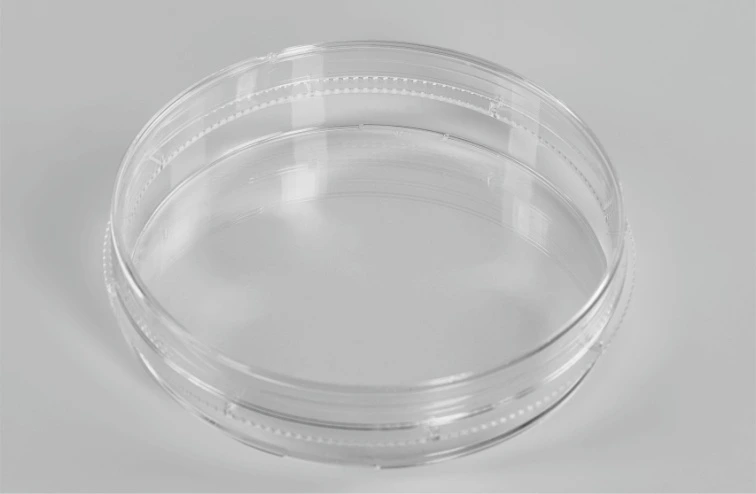
Cell culture dishes for standard adherent and suspension culture applications. Available in 35 mm, 60 mm, 100 mm, and 150 mm formats, each featuring a flat, optically clear bottom for distortion-free microscopic observation without removing the dish from the work surface. The base is marked to facilitate cell location and tracking across passages and time points.
The hand-held ring design allows secure, stable handling while wearing gloves — reducing the risk of contamination events during transfer, media exchange, and observation. A raised outer edge ensures consistent stacking stability during incubation, storage, and transport.
Available in TC-Treated and Suspension surface configurations:
- Optically transparent bottom — flat, distortion-free base allows direct microscopic observation without transferring the dish to a separate vessel
- Base marking — the base is marked to facilitate cell location, colony identification, and tracking across passages and time points
- Hand-held ring design — ergonomic outer ring allows secure, stable handling with standard lab gloves, reducing contamination risk during transfer and media exchange
- Raised outer edge — ensures consistent stacking stability during incubation, bench storage, and transport without slipping or tipping
- TC-Treated surface — hydrophilic treatment promotes cell attachment and monolayer formation for adherent cell lines and primary cells
- Suspension surface — smooth, non-treated interior prevents unwanted cell attachment for suspension cultures and spheroid formation
- Vented lid — supplied lid allows passive gas exchange for consistent CO₂ balance in incubator culture
- Four size formats — 35 mm, 60 mm, 100 mm, and 150 mm to match culture scale from small-volume assays to large-scale expansion
- DNase/RNase, Human DNA, ATP, and Pyrogen-free — certified for sensitive cell culture and molecular applications
- Sterile, individually wrapped — sterility maintained until point of use
| Specification | Detail |
|---|---|
| Material | Virgin polystyrene |
| Available Sizes | 35 mm | 60 mm | 100 mm | 150 mm |
| Surface Treatment | TC-Treated (adherent) or Suspension (non-treated) |
| Lid | Supplied — vented for passive gas exchange |
| Base | Optically transparent, flat bottom for microscopic observation |
| Bottom Marking | Base marked to facilitate cell location and tracking |
| Handling Design | Hand-held ring for secure gloved handling |
| Stacking | Raised outer edge for stable stacking |
| Sterilization Method | Gamma irradiation — dose verification per ISO 11137 |
| Sterility Assurance Level | SAL 10⁻⁶ |
| Quality System | Manufactured under ISO 13485 |
| Biocompatibility | Meets USP Class VI requirements |
| RNase / DNase-free | ✓ Certified |
| Human DNA-free | ✓ Certified |
| Pyrogen-free | ✓ Certified |
| ATP-free | ✓ Certified |
| Sterile | ✓ Yes — individually wrapped |
| Autoclavable | ⚠️ Not Autoclavable |
| Single-Use | ⚠️ Single-Use Only |
- Store in original sealed packaging in a clean, dry environment away from direct sunlight and UV exposure
- Maintain storage temperature between 15°C and 30°C (59°F – 86°F)
- Keep away from excessive humidity
- Do not use dishes from damaged or previously opened packaging
- Handle with gloves using standard aseptic technique inside a biosafety cabinet
- Use the hand-held ring design to minimize contact with the dish body and reduce contamination risk
- Inspect packaging integrity before opening — do not use if seal is compromised
- Single-use only — do not reuse between passages or experiments
- Dispose of used dishes in accordance with your institution's biosafety waste disposal guidelines
Cell culture dishes for standard adherent and suspension culture applications. Available in 35 mm, 60 mm, 100 mm, and 150 mm formats, each featuring a flat, optically clear bottom for distortion-free microscopic observation without removing the dish from the work surface. The base is marked to facilitate cell location and tracking across passages and time points.
The hand-held ring design allows secure, stable handling while wearing gloves — reducing the risk of contamination events during transfer, media exchange, and observation. A raised outer edge ensures consistent stacking stability during incubation, storage, and transport.
Available in TC-Treated and Suspension surface configurations:
- Optically transparent bottom — flat, distortion-free base allows direct microscopic observation without transferring the dish to a separate vessel
- Base marking — the base is marked to facilitate cell location, colony identification, and tracking across passages and time points
- Hand-held ring design — ergonomic outer ring allows secure, stable handling with standard lab gloves, reducing contamination risk during transfer and media exchange
- Raised outer edge — ensures consistent stacking stability during incubation, bench storage, and transport without slipping or tipping
- TC-Treated surface — hydrophilic treatment promotes cell attachment and monolayer formation for adherent cell lines and primary cells
- Suspension surface — smooth, non-treated interior prevents unwanted cell attachment for suspension cultures and spheroid formation
- Vented lid — supplied lid allows passive gas exchange for consistent CO₂ balance in incubator culture
- Four size formats — 35 mm, 60 mm, 100 mm, and 150 mm to match culture scale from small-volume assays to large-scale expansion
- DNase/RNase, Human DNA, ATP, and Pyrogen-free — certified for sensitive cell culture and molecular applications
- Sterile, individually wrapped — sterility maintained until point of use
| Specification | Detail |
|---|---|
| Material | Virgin polystyrene |
| Available Sizes | 35 mm | 60 mm | 100 mm | 150 mm |
| Surface Treatment | TC-Treated (adherent) or Suspension (non-treated) |
| Lid | Supplied — vented for passive gas exchange |
| Base | Optically transparent, flat bottom for microscopic observation |
| Bottom Marking | Base marked to facilitate cell location and tracking |
| Handling Design | Hand-held ring for secure gloved handling |
| Stacking | Raised outer edge for stable stacking |
| Sterilization Method | Gamma irradiation — dose verification per ISO 11137 |
| Sterility Assurance Level | SAL 10⁻⁶ |
| Quality System | Manufactured under ISO 13485 |
| Biocompatibility | Meets USP Class VI requirements |
| RNase / DNase-free | ✓ Certified |
| Human DNA-free | ✓ Certified |
| Pyrogen-free | ✓ Certified |
| ATP-free | ✓ Certified |
| Sterile | ✓ Yes — individually wrapped |
| Autoclavable | ⚠️ Not Autoclavable |
| Single-Use | ⚠️ Single-Use Only |
- Store in original sealed packaging in a clean, dry environment away from direct sunlight and UV exposure
- Maintain storage temperature between 15°C and 30°C (59°F – 86°F)
- Keep away from excessive humidity
- Do not use dishes from damaged or previously opened packaging
- Handle with gloves using standard aseptic technique inside a biosafety cabinet
- Use the hand-held ring design to minimize contact with the dish body and reduce contamination risk
- Inspect packaging integrity before opening — do not use if seal is compromised
- Single-use only — do not reuse between passages or experiments
- Dispose of used dishes in accordance with your institution's biosafety waste disposal guidelines
| Dimension (mm) | Culture Area (cm²) |
Recommended Working Volume (mL) |
Packaging |
|---|---|---|---|
| 35 × 10 | 8.9 | 2.1 – 3.7 | 20 dishes/bag · 25 bags/case |
| 60 × 15 | 21.3 | 4.0 – 7.0 | 10 dishes/bag · 50 bags/case |
| 100 × 20 | 57.2 | 11.3 – 18.8 | 10 dishes/bag · 30 bags/case |
| 150 × 20 | 143.7 | 25.1 – 50.3 | 5 dishes/bag · 20 bags/case |
| Dimension (mm) | Culture Area (cm²) |
Recommended Working Volume (mL) |
Packaging |
|---|---|---|---|
| 35 × 10 | 8.9 | 2.1 – 3.7 | 20 dishes/bag · 25 bags/case |
| 60 × 15 | 21.3 | 4.0 – 7.0 | 10 dishes/bag · 50 bags/case |
| 100 × 20 | 57.2 | 11.3 – 18.8 | 10 dishes/bag · 30 bags/case |
| 150 × 20 | 143.7 | 25.1 – 50.3 | 5 dishes/bag · 20 bags/case |
Frequently Bought Together
These other products might interest you