- All products
- Consumables
- Cryovial and Cryovial Accessories
- Cryovial with Bottom Barcode
- Cryovial and Cryovial Accessories
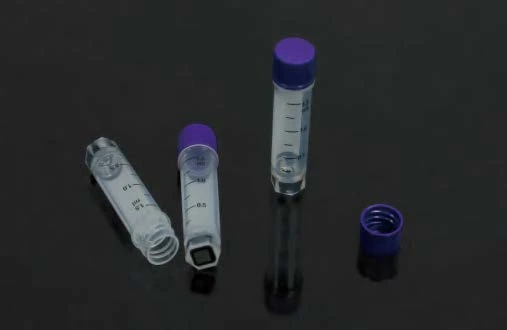
Sterile medical-grade polypropylene cryovials with bottom barcode label area, rated from -196°C to 121°C for vapor phase liquid nitrogen storage and repeated freeze-thaw applications. Available in 0.5, 1.0, 1.5, and 2.0 mL external thread, and 2.0 mL internal thread, and 5.0 mL external thread. The external thread design eliminates the O-ring from cap contact with the sample — reducing the possibility of contamination from rubber seal material. Internal thread vials include an O-ring for maximum leak protection.
Each vial features black graduation printing, a white writing area for direct sample labeling on the tube body, and a self-standing flat base with a blank barcode label area for automated scanning. Supplied sterile, DNase/RNase-free, and endotoxin-free. 50 vials per bag, 1,000 per case.
- Bottom barcode label area — pre-designated blank area on the flat base for barcode labels — enables automated scanning of sample identity directly from the storage box without removing the vial, supporting LIMS integration and high-throughput sample management
- Six volume formats — 0.5, 1.0, 1.5, 2.0, and 5.0 mL to match sample volume requirements across a full range of biobanking and sample management workflows
- Medical-grade polypropylene — consistent structural integrity from -196°C vapor phase liquid nitrogen through 121°C autoclave sterilization
- Wide working temperature range — -196°C to 121°C covers the full range from cryogenic biobanking to autoclave sterilization in a single tube format
- Vapor phase liquid nitrogen compatible — stable for long-term storage in LN2 vapor phase for biobanking, cell line preservation, and biological sample archiving
- Repeated freeze-thaw compatible — withstands multiple freeze-thaw cycles without cracking, deformation, or seal failure
- External thread option (0.5–5.0 mL) — no O-ring in cap reduces the possibility of contamination from rubber seal material contact with the sample
- Internal thread option (2.0 mL) — O-ring sealed cap provides maximum leak protection for demanding cryogenic storage workflows
- White writing area + black graduation printing — direct tube body labeling with permanent marker and clear volume reference markings on all sizes
- Self-standing flat base — stands upright without a rack for convenient rack-free bench use during filling and processing
- Fits standard 9×9 (81-well) cryogenic boxes — compatible with existing biobank storage infrastructure
- Sterile, DNase/RNase-free, endotoxin-free — certified for sensitive biological sample storage and molecular biology applications
| Specification | Detail |
|---|---|
| Material | Medical-grade polypropylene |
| Available Volumes | 0.5 mL | 1.0 mL | 1.5 mL | 2.0 mL | 5.0 mL |
| Thread Options | Internal thread (2.0 mL) | External thread (0.5, 1.0, 1.5, 2.0, 5.0 mL) |
| O-Ring | Internal thread = Yes | External thread = No |
| Bottom Barcode Area | 📷 Yes — blank label area on tube base |
| Working Temperature | ❄ -196°C to 121°C |
| LN2 Vapor Phase | ✓ Stable for vapor phase liquid nitrogen |
| Freeze-Thaw | Compatible with repeated freeze-thaw cycles |
| Base Design | Self-standing flat bottom with barcode label area |
| Labeling | White writing area + black graduation printing on tube body |
| Cryogenic Box Fit | Standard 9×9 (81-well) cryogenic storage boxes |
| Sterile | ✨ Yes — individually packaged sterile |
| Single-Use | ⚠️ Single-use recommended |
| RNase / DNase-free | ✓ Certified |
| Endotoxin-free | ✓ Certified |
| Quality System | Manufactured under ISO 13485 |
| Packaging | 50 vials per bag | 1,000 vials per case |
- Store unused vials in original packaging in a clean, dry environment away from direct sunlight
- Maintain storage temperature between 15°C and 30°C prior to use
- Wear cryogenic gloves and face shield when working with liquid nitrogen storage systems
- Affix barcode label to the designated area on the tube base before filling — apply firmly and smoothly to ensure the label lies flat for accurate scanning
- Verify barcode label adhesive is rated for cryogenic temperatures before use — standard labels may detach at ultra-low temperatures
- Fill vials leaving adequate headspace — do not overfill as liquid expands on freezing
- Ensure screw cap is fully and evenly tightened before placing in cryogenic storage
- For internal thread vials, verify O-ring is correctly seated before tightening cap
- Place vials in standard 9×9 cryogenic storage boxes with barcode facing down for scanner access from below
- Store in vapor phase of liquid nitrogen only — do not submerge vials directly in liquid nitrogen phase
- Single-use only — do not reuse vials between samples
- Thaw vials at 37°C water bath or at room temperature — never use open flame or boiling water
- Dispose of used vials per your institution's biosafety and cryogenic waste disposal guidelines
Sterile medical-grade polypropylene cryovials with bottom barcode label area, rated from -196°C to 121°C for vapor phase liquid nitrogen storage and repeated freeze-thaw applications. Available in 0.5, 1.0, 1.5, and 2.0 mL external thread, and 2.0 mL internal thread, and 5.0 mL external thread. The external thread design eliminates the O-ring from cap contact with the sample — reducing the possibility of contamination from rubber seal material. Internal thread vials include an O-ring for maximum leak protection.
Each vial features black graduation printing, a white writing area for direct sample labeling on the tube body, and a self-standing flat base with a blank barcode label area for automated scanning. Supplied sterile, DNase/RNase-free, and endotoxin-free. 50 vials per bag, 1,000 per case.
- Bottom barcode label area — pre-designated blank area on the flat base for barcode labels — enables automated scanning of sample identity directly from the storage box without removing the vial, supporting LIMS integration and high-throughput sample management
- Six volume formats — 0.5, 1.0, 1.5, 2.0, and 5.0 mL to match sample volume requirements across a full range of biobanking and sample management workflows
- Medical-grade polypropylene — consistent structural integrity from -196°C vapor phase liquid nitrogen through 121°C autoclave sterilization
- Wide working temperature range — -196°C to 121°C covers the full range from cryogenic biobanking to autoclave sterilization in a single tube format
- Vapor phase liquid nitrogen compatible — stable for long-term storage in LN2 vapor phase for biobanking, cell line preservation, and biological sample archiving
- Repeated freeze-thaw compatible — withstands multiple freeze-thaw cycles without cracking, deformation, or seal failure
- External thread option (0.5–5.0 mL) — no O-ring in cap reduces the possibility of contamination from rubber seal material contact with the sample
- Internal thread option (2.0 mL) — O-ring sealed cap provides maximum leak protection for demanding cryogenic storage workflows
- White writing area + black graduation printing — direct tube body labeling with permanent marker and clear volume reference markings on all sizes
- Self-standing flat base — stands upright without a rack for convenient rack-free bench use during filling and processing
- Fits standard 9×9 (81-well) cryogenic boxes — compatible with existing biobank storage infrastructure
- Sterile, DNase/RNase-free, endotoxin-free — certified for sensitive biological sample storage and molecular biology applications
| Specification | Detail |
|---|---|
| Material | Medical-grade polypropylene |
| Available Volumes | 0.5 mL | 1.0 mL | 1.5 mL | 2.0 mL | 5.0 mL |
| Thread Options | Internal thread (2.0 mL) | External thread (0.5, 1.0, 1.5, 2.0, 5.0 mL) |
| O-Ring | Internal thread = Yes | External thread = No |
| Bottom Barcode Area | 📷 Yes — blank label area on tube base |
| Working Temperature | ❄ -196°C to 121°C |
| LN2 Vapor Phase | ✓ Stable for vapor phase liquid nitrogen |
| Freeze-Thaw | Compatible with repeated freeze-thaw cycles |
| Base Design | Self-standing flat bottom with barcode label area |
| Labeling | White writing area + black graduation printing on tube body |
| Cryogenic Box Fit | Standard 9×9 (81-well) cryogenic storage boxes |
| Sterile | ✨ Yes — individually packaged sterile |
| Single-Use | ⚠️ Single-use recommended |
| RNase / DNase-free | ✓ Certified |
| Endotoxin-free | ✓ Certified |
| Quality System | Manufactured under ISO 13485 |
| Packaging | 50 vials per bag | 1,000 vials per case |
- Store unused vials in original packaging in a clean, dry environment away from direct sunlight
- Maintain storage temperature between 15°C and 30°C prior to use
- Wear cryogenic gloves and face shield when working with liquid nitrogen storage systems
- Affix barcode label to the designated area on the tube base before filling — apply firmly and smoothly to ensure the label lies flat for accurate scanning
- Verify barcode label adhesive is rated for cryogenic temperatures before use — standard labels may detach at ultra-low temperatures
- Fill vials leaving adequate headspace — do not overfill as liquid expands on freezing
- Ensure screw cap is fully and evenly tightened before placing in cryogenic storage
- For internal thread vials, verify O-ring is correctly seated before tightening cap
- Place vials in standard 9×9 cryogenic storage boxes with barcode facing down for scanner access from below
- Store in vapor phase of liquid nitrogen only — do not submerge vials directly in liquid nitrogen phase
- Single-use only — do not reuse vials between samples
- Thaw vials at 37°C water bath or at room temperature — never use open flame or boiling water
- Dispose of used vials per your institution's biosafety and cryogenic waste disposal guidelines
Frequently Bought Together
These other products might interest you