- All products
- Kultureware
- Roller Bottles
- Roller Bottles
- Roller Bottles
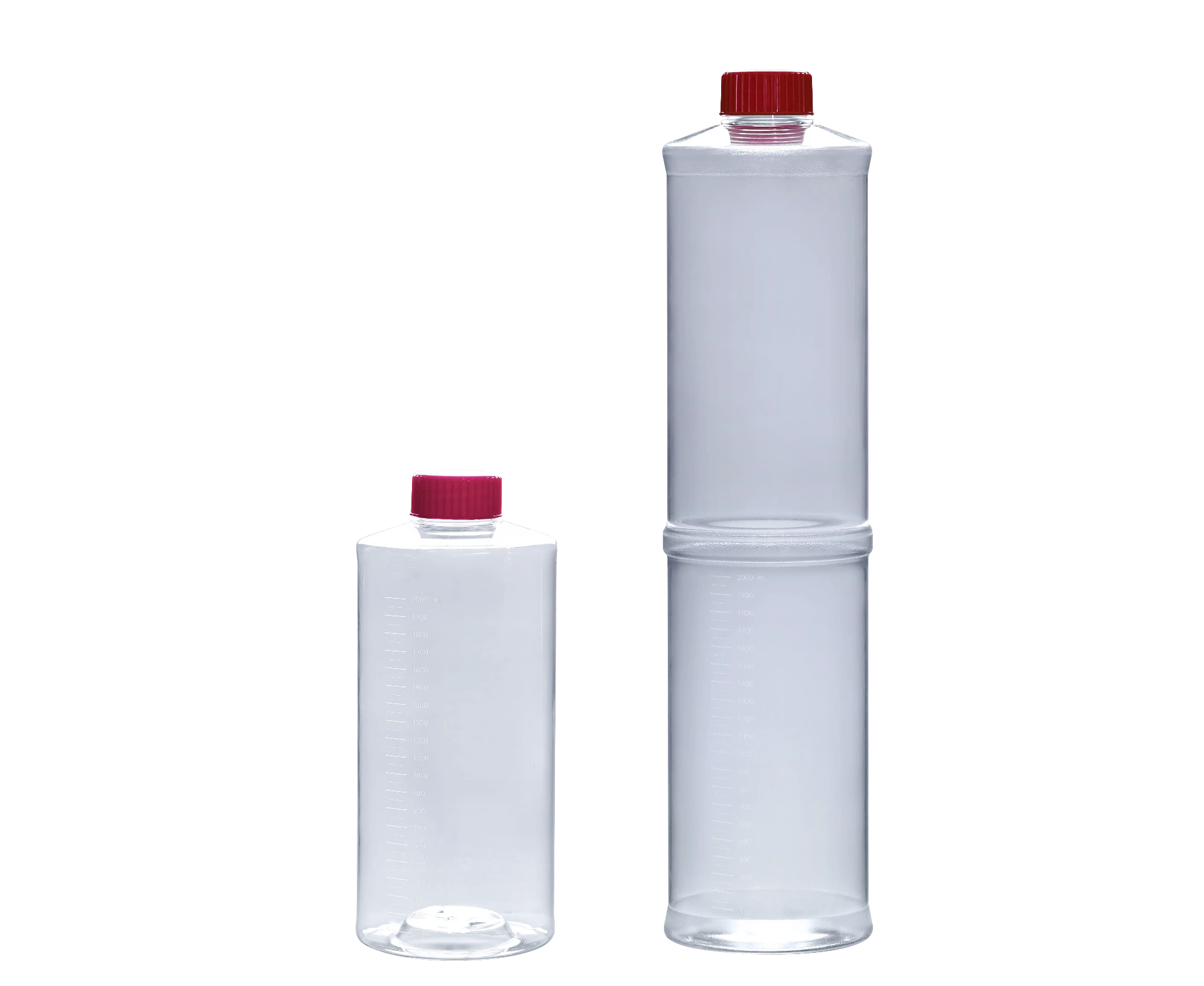
Sterile TC-treated polystyrene roller bottles for large-scale adherent cell culture. Available in 2L and 5L formats with smooth or pleated surface options and plug or vent cap configurations — designed for use on standard roller bottle apparatus for high-yield cell expansion, virus production, and large-scale biologics manufacturing.
The 2L roller bottles feature one-piece polystyrene construction — eliminating weld seams and joints that can create contamination sites or structural weak points. The pleated surface option increases effective growth area by approximately double compared to smooth surface — delivering significantly higher cell yield per bottle without increasing footprint on the roller apparatus.
The 5L roller bottle is constructed in two pieces to accommodate the manufacturing requirements of larger volume formats, and is compatible with standard roller drum apparatus. All bottles are certified DNase/RNase- and endotoxin-free and supplied sterile in 2-bottle bags.
2L Surface Options:
Cap Options:
- TC-treated polystyrene surface — tissue culture treated inner surface for reliable adherent cell attachment and uniform monolayer formation during roller culture
- Pleated surface option (2L) — internal pleating approximately doubles the effective growth surface area compared to smooth surface — maximizing cell yield per bottle without additional roller apparatus positions
- One-piece construction (2L) — seamless single-piece polystyrene manufacturing eliminates weld seams and joints that can harbor contamination or create structural weak points
- 0.22 µm vent cap option — hydrophobic membrane allows continuous passive gas exchange during rolling without opening the cap — reducing contamination risk and simplifying high-throughput workflows
- Plug cap option — fully sealed closure for standard roller culture protocols requiring periodic cap venting
- Compatible with standard roller apparatus — 2L and 5L formats fit standard roller bottle drum systems
- 2L and 5L formats — scale from mid-volume to large-volume production within the same product range
- Sterile — gamma irradiated, dose verification per ISO 11137, SAL 10⁻⁶
- DNase/RNase, Endotoxin, Human DNA, ATP, and Pyrogen-free — certified for sensitive cell culture and biologics production
- Supplied 2 bottles per bag — convenient paired packaging for aseptic handling
| Specification | Detail |
|---|---|
| Material | TC-treated polystyrene |
| Available Volumes | 2L | 5L |
| Surface Options | Smooth | Pleated (2L only) |
| Cap Options | Plug Cap | Vent Cap (0.22 µm hydrophobic membrane) |
| 2L Construction | One-piece polystyrene — no weld seams |
| 5L Construction | Two-piece polystyrene |
| 2L Smooth — Growth Area | ~850 cm² (approximate — confirm with vendor) |
| 2L Pleated — Growth Area | ~1,700 cm² (approximate — confirm with vendor) |
| 2L Working Volume | ~100–300 mL (industry standard recommendation) |
| 5L Working Volume | ~250–750 mL (industry standard recommendation) |
| Roller Apparatus | Compatible with standard roller bottle drum systems |
| Packaging | 2 bottles per bag |
| 2L — Bottles per Case | 40 bottles per case (20 bags) |
| 5L — Bottles per Case | 20 bottles per case (10 bags) |
| Autoclavable | ⚠️ Not Autoclavable — single-use |
| Sterile | ✓ Yes — gamma irradiated |
| Sterilization Method | Gamma irradiation — dose verification per ISO 11137 |
| Sterility Assurance Level | SAL 10⁻⁶ |
| Quality System | Manufactured under ISO 13485 |
| Biocompatibility | Meets USP Class VI requirements |
| RNase / DNase-free | ✓ Certified |
| Endotoxin-free | ✓ Certified |
| Human DNA-free | ✓ Certified |
| Pyrogen-free | ✓ Certified |
| ATP-free | ✓ Certified |
- Store in original packaging in a clean, dry environment away from direct sunlight and UV exposure
- Maintain storage temperature between 15°C and 30°C (59°F – 86°F)
- Keep away from excessive humidity
- Do not use bottles from damaged or previously opened packaging
- Open packaging and seed aseptically inside a biosafety cabinet or laminar flow hood
- Do not fill above the recommended working volume — overfilling reduces gas exchange and monolayer formation quality during rolling
- Ensure cap is fully and securely tightened before placing on roller apparatus
- Set roller apparatus speed per your validated protocol — typically 0.3–1.0 rpm for standard mammalian cell culture
- Inspect bottles for cracks or damage before seeding — do not use damaged bottles
- Single-use only — do not reuse between culture runs
- Dispose of used bottles in accordance with your institution's biosafety waste disposal guidelines
Sterile TC-treated polystyrene roller bottles for large-scale adherent cell culture. Available in 2L and 5L formats with smooth or pleated surface options and plug or vent cap configurations — designed for use on standard roller bottle apparatus for high-yield cell expansion, virus production, and large-scale biologics manufacturing.
The 2L roller bottles feature one-piece polystyrene construction — eliminating weld seams and joints that can create contamination sites or structural weak points. The pleated surface option increases effective growth area by approximately double compared to smooth surface — delivering significantly higher cell yield per bottle without increasing footprint on the roller apparatus.
The 5L roller bottle is constructed in two pieces to accommodate the manufacturing requirements of larger volume formats, and is compatible with standard roller drum apparatus. All bottles are certified DNase/RNase- and endotoxin-free and supplied sterile in 2-bottle bags.
2L Surface Options:
Cap Options:
- TC-treated polystyrene surface — tissue culture treated inner surface for reliable adherent cell attachment and uniform monolayer formation during roller culture
- Pleated surface option (2L) — internal pleating approximately doubles the effective growth surface area compared to smooth surface — maximizing cell yield per bottle without additional roller apparatus positions
- One-piece construction (2L) — seamless single-piece polystyrene manufacturing eliminates weld seams and joints that can harbor contamination or create structural weak points
- 0.22 µm vent cap option — hydrophobic membrane allows continuous passive gas exchange during rolling without opening the cap — reducing contamination risk and simplifying high-throughput workflows
- Plug cap option — fully sealed closure for standard roller culture protocols requiring periodic cap venting
- Compatible with standard roller apparatus — 2L and 5L formats fit standard roller bottle drum systems
- 2L and 5L formats — scale from mid-volume to large-volume production within the same product range
- Sterile — gamma irradiated, dose verification per ISO 11137, SAL 10⁻⁶
- DNase/RNase, Endotoxin, Human DNA, ATP, and Pyrogen-free — certified for sensitive cell culture and biologics production
- Supplied 2 bottles per bag — convenient paired packaging for aseptic handling
| Specification | Detail |
|---|---|
| Material | TC-treated polystyrene |
| Available Volumes | 2L | 5L |
| Surface Options | Smooth | Pleated (2L only) |
| Cap Options | Plug Cap | Vent Cap (0.22 µm hydrophobic membrane) |
| 2L Construction | One-piece polystyrene — no weld seams |
| 5L Construction | Two-piece polystyrene |
| 2L Smooth — Growth Area | ~850 cm² (approximate — confirm with vendor) |
| 2L Pleated — Growth Area | ~1,700 cm² (approximate — confirm with vendor) |
| 2L Working Volume | ~100–300 mL (industry standard recommendation) |
| 5L Working Volume | ~250–750 mL (industry standard recommendation) |
| Roller Apparatus | Compatible with standard roller bottle drum systems |
| Packaging | 2 bottles per bag |
| 2L — Bottles per Case | 40 bottles per case (20 bags) |
| 5L — Bottles per Case | 20 bottles per case (10 bags) |
| Autoclavable | ⚠️ Not Autoclavable — single-use |
| Sterile | ✓ Yes — gamma irradiated |
| Sterilization Method | Gamma irradiation — dose verification per ISO 11137 |
| Sterility Assurance Level | SAL 10⁻⁶ |
| Quality System | Manufactured under ISO 13485 |
| Biocompatibility | Meets USP Class VI requirements |
| RNase / DNase-free | ✓ Certified |
| Endotoxin-free | ✓ Certified |
| Human DNA-free | ✓ Certified |
| Pyrogen-free | ✓ Certified |
| ATP-free | ✓ Certified |
- Store in original packaging in a clean, dry environment away from direct sunlight and UV exposure
- Maintain storage temperature between 15°C and 30°C (59°F – 86°F)
- Keep away from excessive humidity
- Do not use bottles from damaged or previously opened packaging
- Open packaging and seed aseptically inside a biosafety cabinet or laminar flow hood
- Do not fill above the recommended working volume — overfilling reduces gas exchange and monolayer formation quality during rolling
- Ensure cap is fully and securely tightened before placing on roller apparatus
- Set roller apparatus speed per your validated protocol — typically 0.3–1.0 rpm for standard mammalian cell culture
- Inspect bottles for cracks or damage before seeding — do not use damaged bottles
- Single-use only — do not reuse between culture runs
- Dispose of used bottles in accordance with your institution's biosafety waste disposal guidelines
| Configuration | Volume | Surface | Cap | Construction | Bottles/ Bag |
Bottles/ Case |
|---|---|---|---|---|---|---|
| 2L Smooth — Plug | 2L | Smooth | Plug Cap | One-piece | 2 | 40 |
| 2L Smooth — Vent | 2L | Smooth | Vent Cap | One-piece | 2 | 40 |
| 2L Pleated — Plug | 2L | Pleated | Plug Cap | One-piece | 2 | 40 |
| 2L Pleated — Vent | 2L | Pleated | Vent Cap | One-piece | 2 | 40 |
| 5L — Plug | 5L | Standard | Plug Cap | Two-piece | 2 | 20 |
| 5L — Vent | 5L | Standard | Vent Cap | Two-piece | 2 | 20 |
| Configuration | Volume | Surface | Cap | Construction | Bottles/ Bag |
Bottles/ Case |
|---|---|---|---|---|---|---|
| 2L Smooth — Plug | 2L | Smooth | Plug Cap | One-piece | 2 | 40 |
| 2L Smooth — Vent | 2L | Smooth | Vent Cap | One-piece | 2 | 40 |
| 2L Pleated — Plug | 2L | Pleated | Plug Cap | One-piece | 2 | 40 |
| 2L Pleated — Vent | 2L | Pleated | Vent Cap | One-piece | 2 | 40 |
| 5L — Plug | 5L | Standard | Plug Cap | Two-piece | 2 | 20 |
| 5L — Vent | 5L | Standard | Vent Cap | Two-piece | 2 | 20 |
Frequently Bought Together
These other products might interest you