- All products
- Cell Lines
- HEK293 / hPD-L1 Expression Stable Cells
- Cell Lines
Internal Reference:
KCL-ENG-102
⚠ FOR RESEARCH USE ONLY — Not for diagnostic or therapeutic procedures
KCL-ENG-102 is a clonal, antibiotic-selected HEK293 cell line engineered to stably express full-length human Programmed Death Ligand 1 (hPD-L1, also known as CD274) under a CMV promoter. The PD-L1 transgene is expressed untagged, preserving native protein conformation for antibody binding and functional assay work.
The line was generated by lentiviral transduction or piggyBac transposon integration and selected using puromycin resistance to ensure stable, clonal integration of the transgene. Expression is maintained under continuous puromycin selection for over 20 passages with greater than 95% of cells expressing hPD-L1 by flow cytometry.
This cell line is well-suited for studies of PD-1/PD-L1 checkpoint biology, screening of immune checkpoint modulators, and validation of anti-PD-L1 antibodies and small molecules. All lots are quality-tested prior to release for expression level, post-thaw viability, mycoplasma, and STR identity.
DMEM supplemented with 10% heat-inactivated FBS and 1% Pen/Strep. For routine maintenance under selection, add Puromycin at 0.5 to 1.0 μg/mL. Allow cells to recover in selection-free medium for 48 hours after thawing before reintroducing Puromycin.
All lots are quality tested prior to release. The following characterization data is generated for each production lot.
| Parameter | Result | Specification |
|---|---|---|
| hPD-L1 / CD274 expression | ✓ Positive | >95% by flow cytometry; MFI ~12,000 |
| Expression stability | ✓ Stable | Stable for >20 passages under Puromycin selection |
| Post-thaw viability | ✓ Pass | >80% by trypan blue exclusion |
| Cell line identity (STR profiling) | ✓ Confirmed | Matches HEK293 reference profile |
| Transgene | ✓ Confirmed | Full-length hPD-L1 / CD274 (NCBI RefSeq: NP_054862.1), untagged |
| Selection marker | ✓ Confirmed | Puromycin resistance (PAC gene) |
| Test | Result |
|---|---|
| Mycoplasma | ✗ Negative |
| Bacteria | ✗ Negative |
| Fungi | ✗ Negative |
Certificates of Analysis with complete QC data, including flow cytometry histograms and STR profile, are available upon request. Contact Kulture Scientific with your lot number.
KCL-ENG-102 is shipped as a cryopreserved vial on dry ice. Follow the steps below upon receipt. Detailed thawing, plating, and subculture protocols are available on the Kulture Scientific protocol page.
Subculture at 80 to 90% confluence using 0.25% Trypsin-EDTA. Split 1:4 to 1:6 every 2 to 3 days. Maintain under Puromycin selection (0.5 to 1.0 μg/mL) to preserve stable expression. Full subculture and cryopreservation protocols are available on the Kulture Scientific protocol page.
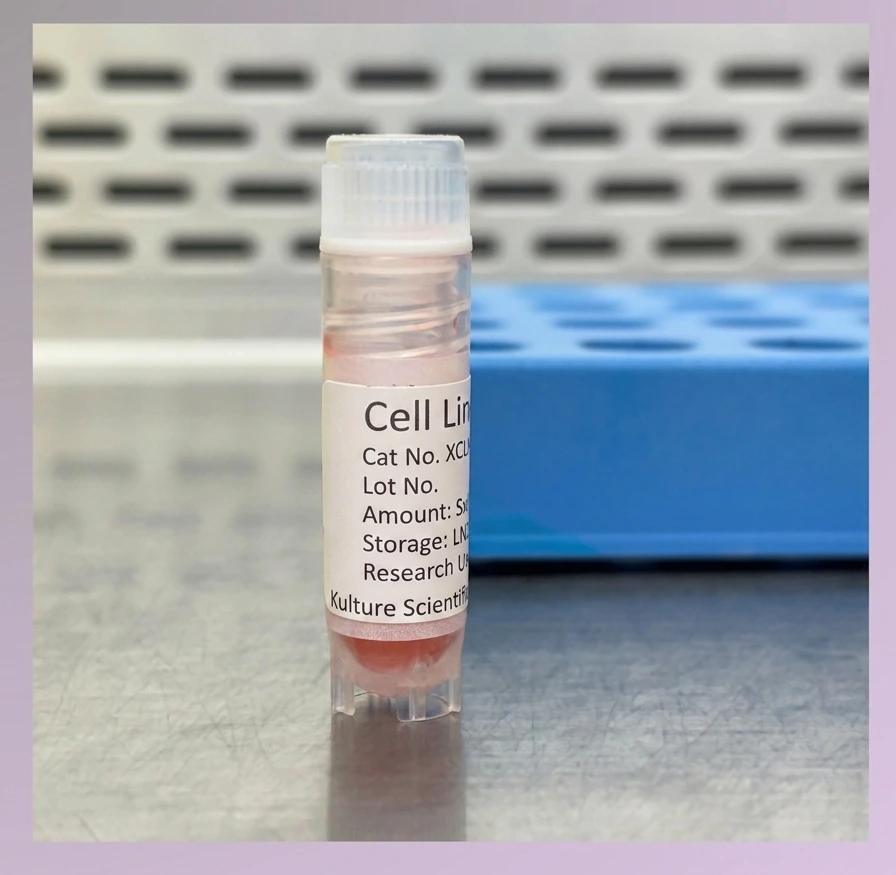
KCL-ENG-102 is available as a cryopreserved vial containing at least 5×10&sup5; viable cells in cryoprotective medium containing DMSO.
| Product | Cat. No. | Format | Cell Number |
|---|---|---|---|
| HEK293 / hPD-L1 Expression Stable Cells | KCL-ENG-102 | Cryopreserved Vial | ≥5×10⁵ cells/vial |
- Long-term storage — store in liquid nitrogen vapor phase (−150°C to −196°C); cells are stable until the expiry date on the vial label when maintained under correct cryogenic conditions
- Do not store at −80°C or −20°C — neither temperature is suitable for long-term cell storage; ice crystal formation at these temperatures will irreversibly damage cell membranes and compromise viability
- Temperature sensitivity — minimize time outside cryogenic storage; cells are sensitive to temperature fluctuations
- Freeze-thaw cycles — repeated freeze-thaw cycles compromise cell viability and expression stability; thaw only what is needed for immediate use
- Shipping condition — cryopreserved vials are shipped on dry ice; inspect dry ice upon receipt and transfer vials promptly
- DMSO content — cryoprotective medium contains DMSO; wear nitrile gloves during thaw procedures and avoid contact with skin
- Certificate of Analysis — lot-specific QC documentation including flow cytometry data, viability, and STR profile available upon request
For research purposes only. Not for use in diagnostic or therapeutic procedures. This product has not been tested or validated for clinical use. Not for direct administration into humans or animals.
This cell line should be handled under Biosafety Level 2 (BSL-2) conditions based on the following characteristics:
- Human-derived origin — all human-derived cell lines require BSL-2 containment under Universal Precautions regardless of donor screening status
- Lentiviral transduction history — the line was generated using lentiviral vectors; replication-incompetent lentivirally transduced lines are classified as BSL-2 by most institutional biosafety committees
- Stable transgene integration — integrated transgene expression warrants appropriate institutional review and containment
Users must consult their institutional biosafety committee (IBC) prior to use. Individual institutions may impose additional requirements based on local policy.
- Human-derived material — treat as potentially infectious; follow BSL-2 guidelines for handling human-derived cell lines
- Lentiviral transduction history — handle in accordance with your IBC guidelines for lentivirally transduced cell lines; verify institutional requirements before use
- DMSO (cryoprotectant) — cryopreserved vials contain DMSO, a skin-penetrating solvent; wear nitrile gloves at all times during thawing
- Puromycin — handle antibiotic selection reagents in accordance with institutional chemical safety guidelines
- Disposal — decontaminate all cell culture waste with an appropriate disinfectant (e.g., 10% bleach) prior to disposal in accordance with local biohazardous waste regulations
⚠ FOR RESEARCH USE ONLY — Not for diagnostic or therapeutic procedures
KCL-ENG-102 is a clonal, antibiotic-selected HEK293 cell line engineered to stably express full-length human Programmed Death Ligand 1 (hPD-L1, also known as CD274) under a CMV promoter. The PD-L1 transgene is expressed untagged, preserving native protein conformation for antibody binding and functional assay work.
The line was generated by lentiviral transduction or piggyBac transposon integration and selected using puromycin resistance to ensure stable, clonal integration of the transgene. Expression is maintained under continuous puromycin selection for over 20 passages with greater than 95% of cells expressing hPD-L1 by flow cytometry.
This cell line is well-suited for studies of PD-1/PD-L1 checkpoint biology, screening of immune checkpoint modulators, and validation of anti-PD-L1 antibodies and small molecules. All lots are quality-tested prior to release for expression level, post-thaw viability, mycoplasma, and STR identity.
DMEM supplemented with 10% heat-inactivated FBS and 1% Pen/Strep. For routine maintenance under selection, add Puromycin at 0.5 to 1.0 μg/mL. Allow cells to recover in selection-free medium for 48 hours after thawing before reintroducing Puromycin.
All lots are quality tested prior to release. The following characterization data is generated for each production lot.
| Parameter | Result | Specification |
|---|---|---|
| hPD-L1 / CD274 expression | ✓ Positive | >95% by flow cytometry; MFI ~12,000 |
| Expression stability | ✓ Stable | Stable for >20 passages under Puromycin selection |
| Post-thaw viability | ✓ Pass | >80% by trypan blue exclusion |
| Cell line identity (STR profiling) | ✓ Confirmed | Matches HEK293 reference profile |
| Transgene | ✓ Confirmed | Full-length hPD-L1 / CD274 (NCBI RefSeq: NP_054862.1), untagged |
| Selection marker | ✓ Confirmed | Puromycin resistance (PAC gene) |
| Test | Result |
|---|---|
| Mycoplasma | ✗ Negative |
| Bacteria | ✗ Negative |
| Fungi | ✗ Negative |
Certificates of Analysis with complete QC data, including flow cytometry histograms and STR profile, are available upon request. Contact Kulture Scientific with your lot number.
KCL-ENG-102 is shipped as a cryopreserved vial on dry ice. Follow the steps below upon receipt. Detailed thawing, plating, and subculture protocols are available on the Kulture Scientific protocol page.
Subculture at 80 to 90% confluence using 0.25% Trypsin-EDTA. Split 1:4 to 1:6 every 2 to 3 days. Maintain under Puromycin selection (0.5 to 1.0 μg/mL) to preserve stable expression. Full subculture and cryopreservation protocols are available on the Kulture Scientific protocol page.
KCL-ENG-102 is available as a cryopreserved vial containing at least 5×10&sup5; viable cells in cryoprotective medium containing DMSO.
| Product | Cat. No. | Format | Cell Number |
|---|---|---|---|
| HEK293 / hPD-L1 Expression Stable Cells | KCL-ENG-102 | Cryopreserved Vial | ≥5×10⁵ cells/vial |
- Long-term storage — store in liquid nitrogen vapor phase (−150°C to −196°C); cells are stable until the expiry date on the vial label when maintained under correct cryogenic conditions
- Do not store at −80°C or −20°C — neither temperature is suitable for long-term cell storage; ice crystal formation at these temperatures will irreversibly damage cell membranes and compromise viability
- Temperature sensitivity — minimize time outside cryogenic storage; cells are sensitive to temperature fluctuations
- Freeze-thaw cycles — repeated freeze-thaw cycles compromise cell viability and expression stability; thaw only what is needed for immediate use
- Shipping condition — cryopreserved vials are shipped on dry ice; inspect dry ice upon receipt and transfer vials promptly
- DMSO content — cryoprotective medium contains DMSO; wear nitrile gloves during thaw procedures and avoid contact with skin
- Certificate of Analysis — lot-specific QC documentation including flow cytometry data, viability, and STR profile available upon request
For research purposes only. Not for use in diagnostic or therapeutic procedures. This product has not been tested or validated for clinical use. Not for direct administration into humans or animals.
This cell line should be handled under Biosafety Level 2 (BSL-2) conditions based on the following characteristics:
- Human-derived origin — all human-derived cell lines require BSL-2 containment under Universal Precautions regardless of donor screening status
- Lentiviral transduction history — the line was generated using lentiviral vectors; replication-incompetent lentivirally transduced lines are classified as BSL-2 by most institutional biosafety committees
- Stable transgene integration — integrated transgene expression warrants appropriate institutional review and containment
Users must consult their institutional biosafety committee (IBC) prior to use. Individual institutions may impose additional requirements based on local policy.
- Human-derived material — treat as potentially infectious; follow BSL-2 guidelines for handling human-derived cell lines
- Lentiviral transduction history — handle in accordance with your IBC guidelines for lentivirally transduced cell lines; verify institutional requirements before use
- DMSO (cryoprotectant) — cryopreserved vials contain DMSO, a skin-penetrating solvent; wear nitrile gloves at all times during thawing
- Puromycin — handle antibiotic selection reagents in accordance with institutional chemical safety guidelines
- Disposal — decontaminate all cell culture waste with an appropriate disinfectant (e.g., 10% bleach) prior to disposal in accordance with local biohazardous waste regulations
Frequently Bought Together
These other products might interest you