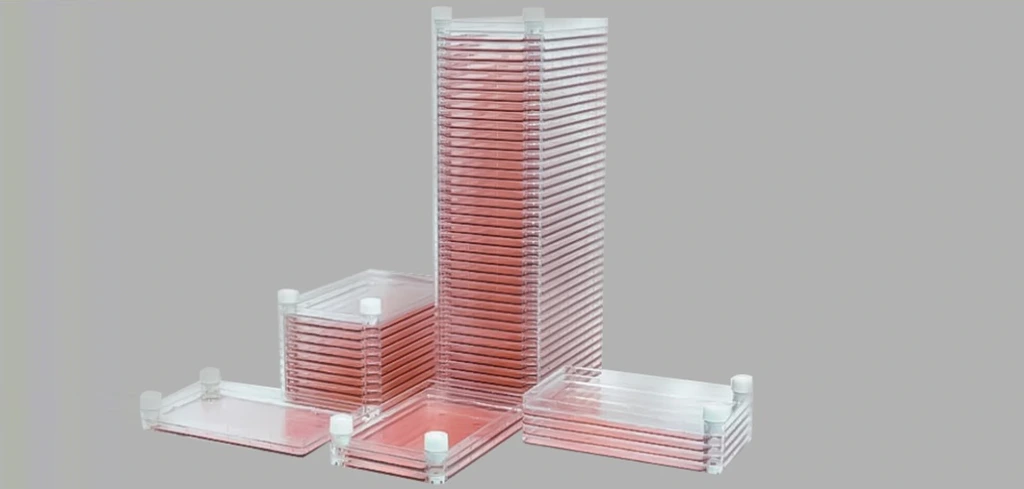
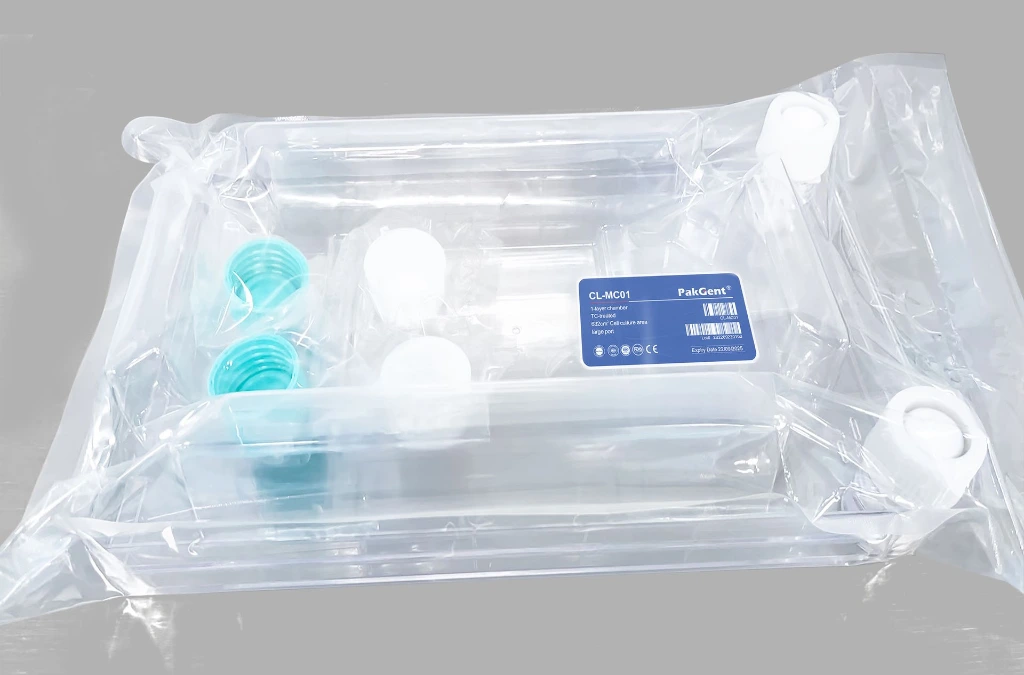


The Cell Factory system is a scalable, closed large-port cell factory platform designed for the production of human and animal vaccines, therapeutic proteins, cell therapy products, and gene therapy products. Available in 1, 2, 4, 10, and 40-layer configurations, the system provides a seamless path from manual R&D operations to large-scale closed production without changing workflow or equipment.
Each unit is constructed from TC-treated polystyrene chambers assembled using ultrasonic welding technology — eliminating the adhesive and solvent bonding used by competing products. The adhesive-free construction removes potential contamination sources and improves structural integrity across the full growth surface area.
The standard large-port design facilitates rapid liquid perfusion, draining, and balancing across all layers simultaneously, while providing enhanced ventilation conditions for optimal cell culture performance. Compatible with standard MPC tube assembly accessories for closed system operation.
Available Layer Configurations:
- Scalable 1 to 40-layer configurations — seamlessly scale from 632 cm² (1-layer R&D) to 25,265 cm² (40-layer production) without changing workflow, reagents, or operational procedures
- Standard large-port design — facilitates rapid liquid perfusion, complete draining, and balanced media distribution across all layers simultaneously — reducing handling time and contamination risk
- No adhesive or solvent construction — polystyrene chambers are assembled using ultrasonic welding — eliminating glue and solvent-based bonding that can leach contaminants into culture media
- TC-treated polystyrene surface — tissue culture treated growth surface for reliable adherent cell attachment and monolayer formation across all layers
- Closed system compatibility — standard large-port design compatible with MPC tube assembly accessories for fully closed liquid handling — supporting GMP and biosafety requirements
- Seamless R&D to production transition — standard port design allows customers to switch between manual R&D operations and large-scale closed production without process changes
- Suitable for regulated production applications — designed for vaccine production, therapeutic protein expression, cell therapy, and gene therapy manufacturing workflows
- DNase/RNase, Endotoxin, Human DNA, ATP, and Pyrogen-free — certified for sensitive biological production applications
- Sterile — SAL 10⁻⁶, manufactured under ISO 13485, meets USP Class VI requirements
| Specification | Detail |
|---|---|
| Material | TC-treated polystyrene chambers |
| Assembly Method | Ultrasonic welding — no adhesive or solvent |
| Port Design | Standard large-port for rapid perfusion and drainage |
| Growth Surface Treatment | TC-treated — optimized for adherent cell attachment |
| Available Configurations | 1-layer | 2-layer | 4-layer | 10-layer | 40-layer |
| 1-Layer Growth Area | 632 cm² | 335 × 205 × 36 mm |
| 2-Layer Growth Area | 1,264 cm² | 335 × 205 × 53 mm |
| 4-Layer Growth Area | 2,526 cm² | 335 × 205 × 87 mm |
| 10-Layer Growth Area | 6,316 cm² | 335 × 205 × 189 mm |
| 40-Layer Growth Area | 25,265 cm² | 335 × 205 × 698 mm |
| Case Quantity — 1 to 10 Layer | 6 units per case |
| Case Quantity — 40 Layer | 2 units per case |
| Autoclavable | ⚠️ Not Autoclavable — single-use |
| Sterile | ✓ Yes — pre-sterilized |
| Sterility Assurance Level | SAL 10⁻⁶ |
| Quality System | Manufactured under ISO 13485 |
| Biocompatibility | Meets USP Class VI requirements |
| RNase / DNase-free | ✓ Certified |
| Endotoxin-free | ✓ Certified |
| Human DNA-free | ✓ Certified |
| Pyrogen-free | ✓ Certified |
| ATP-free | ✓ Certified |
| Applications | Vaccine production, therapeutic proteins, cell therapy, gene therapy |
- Store in original packaging in a clean, dry environment away from direct sunlight and UV exposure
- Maintain storage temperature between 15°C and 30°C (59°F – 86°F)
- Keep away from excessive humidity
- Do not use units from damaged or previously opened packaging
- Handle using standard GMP aseptic technique — open and set up inside a biosafety cabinet or laminar flow hood
- Connect MPC tube assembly accessories using aseptic technique before introducing culture media
- Inspect unit for damage before use — do not use units showing cracks, deformation, or seal compromise
- Single-use only — do not reuse between culture runs
- Dispose of used units in accordance with your institution's biosafety and regulatory waste disposal requirements
The Cell Factory system is a scalable, closed large-port cell factory platform designed for the production of human and animal vaccines, therapeutic proteins, cell therapy products, and gene therapy products. Available in 1, 2, 4, 10, and 40-layer configurations, the system provides a seamless path from manual R&D operations to large-scale closed production without changing workflow or equipment.
Each unit is constructed from TC-treated polystyrene chambers assembled using ultrasonic welding technology — eliminating the adhesive and solvent bonding used by competing products. The adhesive-free construction removes potential contamination sources and improves structural integrity across the full growth surface area.
The standard large-port design facilitates rapid liquid perfusion, draining, and balancing across all layers simultaneously, while providing enhanced ventilation conditions for optimal cell culture performance. Compatible with standard MPC tube assembly accessories for closed system operation.
Available Layer Configurations:
- Scalable 1 to 40-layer configurations — seamlessly scale from 632 cm² (1-layer R&D) to 25,265 cm² (40-layer production) without changing workflow, reagents, or operational procedures
- Standard large-port design — facilitates rapid liquid perfusion, complete draining, and balanced media distribution across all layers simultaneously — reducing handling time and contamination risk
- No adhesive or solvent construction — polystyrene chambers are assembled using ultrasonic welding — eliminating glue and solvent-based bonding that can leach contaminants into culture media
- TC-treated polystyrene surface — tissue culture treated growth surface for reliable adherent cell attachment and monolayer formation across all layers
- Closed system compatibility — standard large-port design compatible with MPC tube assembly accessories for fully closed liquid handling — supporting GMP and biosafety requirements
- Seamless R&D to production transition — standard port design allows customers to switch between manual R&D operations and large-scale closed production without process changes
- Suitable for regulated production applications — designed for vaccine production, therapeutic protein expression, cell therapy, and gene therapy manufacturing workflows
- DNase/RNase, Endotoxin, Human DNA, ATP, and Pyrogen-free — certified for sensitive biological production applications
- Sterile — SAL 10⁻⁶, manufactured under ISO 13485, meets USP Class VI requirements
| Specification | Detail |
|---|---|
| Material | TC-treated polystyrene chambers |
| Assembly Method | Ultrasonic welding — no adhesive or solvent |
| Port Design | Standard large-port for rapid perfusion and drainage |
| Growth Surface Treatment | TC-treated — optimized for adherent cell attachment |
| Available Configurations | 1-layer | 2-layer | 4-layer | 10-layer | 40-layer |
| 1-Layer Growth Area | 632 cm² | 335 × 205 × 36 mm |
| 2-Layer Growth Area | 1,264 cm² | 335 × 205 × 53 mm |
| 4-Layer Growth Area | 2,526 cm² | 335 × 205 × 87 mm |
| 10-Layer Growth Area | 6,316 cm² | 335 × 205 × 189 mm |
| 40-Layer Growth Area | 25,265 cm² | 335 × 205 × 698 mm |
| Case Quantity — 1 to 10 Layer | 6 units per case |
| Case Quantity — 40 Layer | 2 units per case |
| Autoclavable | ⚠️ Not Autoclavable — single-use |
| Sterile | ✓ Yes — pre-sterilized |
| Sterility Assurance Level | SAL 10⁻⁶ |
| Quality System | Manufactured under ISO 13485 |
| Biocompatibility | Meets USP Class VI requirements |
| RNase / DNase-free | ✓ Certified |
| Endotoxin-free | ✓ Certified |
| Human DNA-free | ✓ Certified |
| Pyrogen-free | ✓ Certified |
| ATP-free | ✓ Certified |
| Applications | Vaccine production, therapeutic proteins, cell therapy, gene therapy |
- Store in original packaging in a clean, dry environment away from direct sunlight and UV exposure
- Maintain storage temperature between 15°C and 30°C (59°F – 86°F)
- Keep away from excessive humidity
- Do not use units from damaged or previously opened packaging
- Handle using standard GMP aseptic technique — open and set up inside a biosafety cabinet or laminar flow hood
- Connect MPC tube assembly accessories using aseptic technique before introducing culture media
- Inspect unit for damage before use — do not use units showing cracks, deformation, or seal compromise
- Single-use only — do not reuse between culture runs
- Dispose of used units in accordance with your institution's biosafety and regulatory waste disposal requirements
Frequently Bought Together
These other products might interest you